
An open letter to the Webster Groves Community
October 09, 2026
By Webster University President Tim Keane
Webster University was asked to share information about potential future uses of the Luhr building with the Historic Preservation Commission of Webster Groves on October 13. The monthly meeting has a packed agenda, so this open letter is to memorialize the true nature of the historical partnership between Webster University and the City of Webster Groves, as well as the many ways Webster University contributes to ensuring that the home of our Flagship Campus remains a thriving community.
Historic Preservation
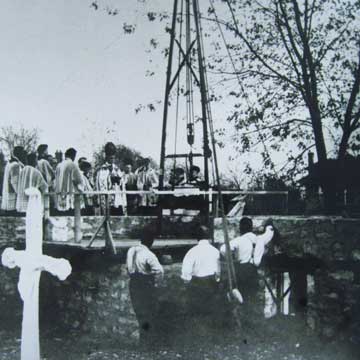
Photo: (1915) Community members help lay the cornerstone for Webster Hall.
More than a century ago when the Sisters of Loretto saw a need to help women earn an advanced education, it was Benjamin Webster who answered the call. He offered his former home to the Sisters for the construction of "Loretto Seminary” for the education of young women in 1897 and later acknowledged in letters that he did so because of the need for advanced education in the community. In 1915, Webster Hall was constructed on that site, becoming the home for the University and a major landmark in the community.
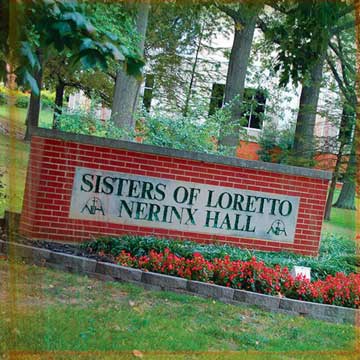
Photo: Sign for Nerinx Hall High School. Date unknown
With foresight, the Sisters of Loretto purchased land from Richard Lockwood in 1922 and moved the education of high school girls to the Lockwood Mansion. This was done to meet the new accreditation standards for the College – the accrediting agency did not recognize high school education - while meeting the demand from the community that high school education still be offered by the Sisters. Webster professors and Webster University education students taught classes at Nerinx for many years. In 1953, a new “Nerinx Hall” was built on the property and has been expanded numerous times over the years. It is still operated by the Sisters of Loretto.
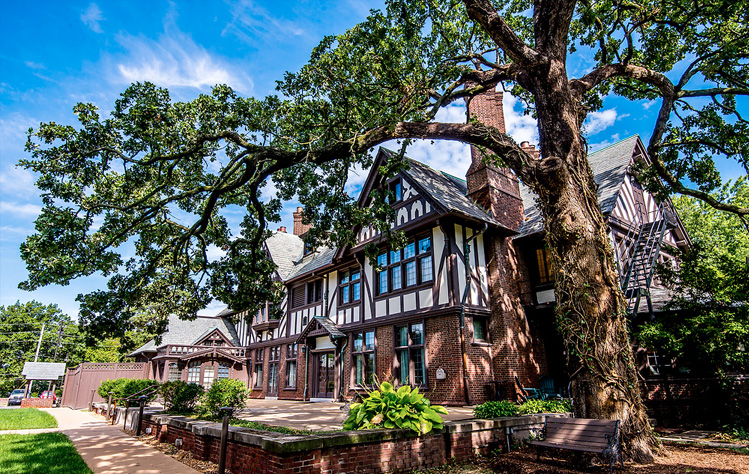
Photo: The Thompson Music House
A search of Webster University’s archives uncovers another important relationship with a philanthropic minded resident, Frank Thompson, a banker and owner of the Carondelet Foundry. Mr. Thompson was an avid gardener who invited students from Webster College to use his elaborate garden for botany lessons. After his death, his house was left to the Episcopalian Church, which used the house as the residence for the Bishop of the Episcopal Diocese of Missouri as well as their diocesan retreat, By the late 1950s, the church needed a larger space. Webster University owned the Culver House in West County, near Ballas and Ladue Roads, which met the needs of the Episcopalian Church. In the spirit of cooperation, the two entities traded properties. Today, the Thompson House is home to Webster University’s Leigh Gerdine College of Fine Arts. In 1982, The Thompson House was added to the National Register of Historic Places.
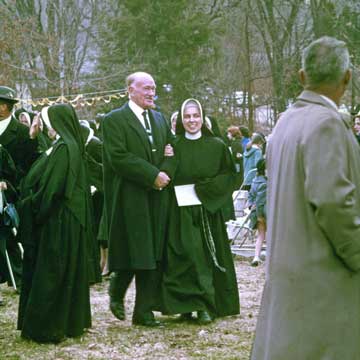
Photo: Conrad Hilton with Sister Jacqueline at the 1964 groundbreaking for the Loretto-Hilton Center. Construction was completed in 1966.
In the late 1950’s, the Sisters of Loretto envisioned a performing arts center to enhance the lives of Webster’s students and provide the Webster Groves community with a destination for world class performances closer to home. Conrad Hilton, the founder of the international chain of hotels, was educated in schools run by the Sisters of Loretto. After reminding Mr. Hilton of his foundational values seeded by the Sisters (for more than three years), the hotelier relented to the Sisters’ and invested in building the Loretto-Hilton Center for Performing Arts. This year the Loretto-Hilton is celebrating 60 years of hosting world class performing arts, right here in Webster Groves.
Shortly after the Loretto-Hilton Center opened, Webster faculty, staff and students organized programs to bring unique and original plays and operas to Webster Groves, citing the lack of those arts in the St. Louis region. Those grew into The Repertory Theatre of St. Louis and the Opera Theatre of St. Louis, two arts organizations that play into the heart of the city’s most recent self-affirmation as the “City of the Arts.”
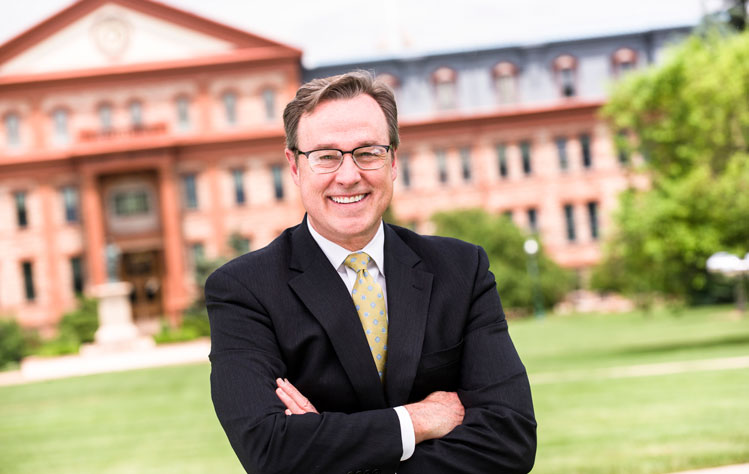
Photo: Tim Keane
Flash forward to today. When I arrived at Webster in August of 2024, the University was facing significant financial challenges. Every Webster resident I met, and indeed every St. Louisan I talked with, implored me to do everything I could to prevent Webster University from shuttering like Fontbonne.
Having been born and raised about 10 minutes away from Webster Groves near Grant’s Farm, the challenge was personal, and the fear was real. According to the Wall Street Journal more than 500 non-profit, four-year universities, have closed in the last decade.
Through an inclusive, transparent and innovative Kairos Strategic Plan that required the commitment and extraordinary resilience of our entire Webster University Community, our University – Webster Groves’ University – finished each of the last two years with a positive cash flow. That had not happened in more than a decade.
So, what does that mean to residents of Webster Groves?
First, Webster Groves has bragging rights as the home of “The Higher Ed Unicorn.” Despite barriers outside of our control that forced the closure of universities, like federal policies condemning the very values that connect Webster University and Webster Groves (i.e. embracing diversity and offering access to education from people of all walks of life), Webster University is thriving.
Second, and beyond our financial renaissance, what makes Webster University The Higher Ed Unicorn is our global reach. No other university in the United States has as many international locations as Webster University, with locations across Europe and Asia.
Third, The Unicorn’s economic impact on the City of Webster Groves is enormous:
- Webster University is the largest employer in the City of Webster Groves.
- According to one study, Webster University students and employees add an estimated $88 million annually to the Webster Groves economy.
- Webster University pays more than $300,000 per year in personal property taxes even though our status as a non-profit does not require us to do so.
- Webster University sold more than a dozen houses in the last year because the Kairos plan focused our team on pursuing our mission, which does not include being a landlord. Those houses provided a significant opportunity for wonderful families to join one of the most welcoming cities in the St. Louis region.
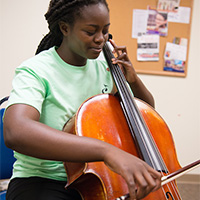
Photo: (2024) A Community Music School student plays cello on the Webster University campus.
As important as Webster University’s economic impact is to the City of Webster Groves, some might see our contribution to the culture of the City as even more vital. Webster University is second in the state of Missouri behind WashU in enrollments of international students, adding to the cultural mosaic of Webster Groves. More tangibly, the Webster Groves City Council just officially adopted “The City of the Arts” as its tagline. Webster University’s contribution to that differentiator includes:
- The Virginia Browning Mainstage in the Loretto-Hilton Center
- The Emerson Studio Theatre in the Loretto-Hilton Center
- The Dot Theatrical Performance Stage in Webster Hall
- The Kooyumjian Photo Gallery
- The Hunt Art Gallery
- The Community Music School
- The Webster University Dance Studio
- The Performance Stage in the Thompson House
- Numerous sculptures throughout Webster’s campus, including many by internationally recognized artists
- Unique art throughout Webster University’s buildings, including several early Warhol’s.
Webster University’s impact on the City of Webster Groves is more than numbers and history. It’s about generations of students, employees, alumni, artists, educators, neighbors and community partners who have helped make Webster Groves the community it is today. Webster University and the community are inseparable, and neither would be what they are without the other.
So here is to the bond between the University and the City. Webster is proud of its history and looks forward to continuing its partnership with the Webster Groves Community.
Visit our website to learn more about how the University positively impacts the community.