
Internationalization of Higher Education: Practices and Challenges of ‘Going Global’
February 05, 2026
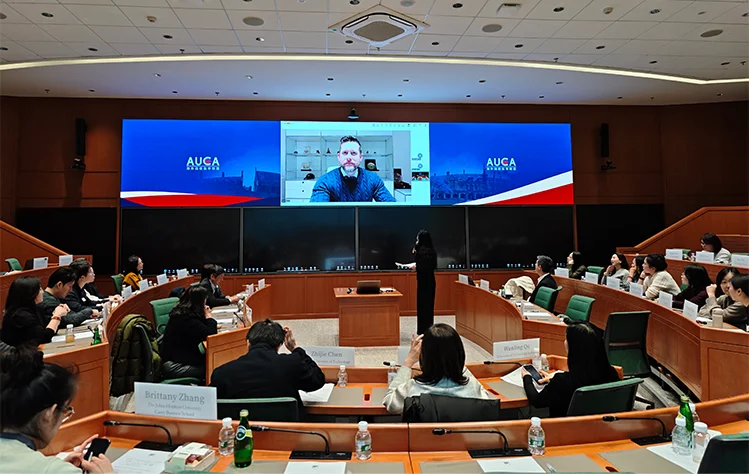
Photo: Ryan Guffey, PhD, Executive Vice President of Webster International, leads
a presentation on Webster's three-pronged model for international growth.
More than 30 senior educators and administrators from leading universities in China, the United States, Europe and Australia gathered Jan. 30 at the Harvard Business Review Beijing Center for a high-level forum titled, “Internationalization of Higher Education: Practices and Challenges for Universities ‘Going Global.’” The event focused on sharing strategies for advancing university internationalization amid an increasingly complex geopolitical environment.
Participants included representatives from the Harvard Business School, the Harvard Shanghai Center, the Stanford University Beijing Center, Duke Kunshan University, Tsinghua University and Peking University, among other institutions. A highlight of the forum was the virtual presentation by Dr. Ryan Guffey, Executive Vice President of Webster International, who detailed Webster University’s pioneering, multi-faceted approach to global operations.
Guffey outlined Webster’s three-pronged model for international growth. First, the University directly owns and operates flagship campuses in Europe, such as its first international location in Geneva (1978), maintaining rigorous academic standards with a selective, low-volume enrollment model. Second, Webster engages in strategic joint partnerships, exemplified by its collaboration with the Shanghai University of Finance and Economics and The University of Electronic Science and Technology of China, where Webster provides academic oversight and curriculum while the local partner manages external relations and logistics. Third, and most distinctively, Webster has developed a seamless global campus system, enabling students to begin their studies at one campus — for instance, in St. Louis — and transition freely to any other Webster campus worldwide, including those in Europe or Asia, without reapplying, changing majors or facing differential tuition rates.
This integrated model, Guffey explained, strategically prioritizes high-demand STEM and outcome-based disciplines, ensuring global market relevance and enhanced student employability. He emphasized that this flexible, student-centered structure is essential for fostering a resilient and truly global learning community, one that promotes cross-cultural engagement and professional networking as integral components of contemporary higher education.
The forum also featured in-depth case studies on Harvard Business School’s deep localization in China, Duke Kunshan University’s establishment and evolution, and the operational challenges encountered by Chinese universities expanding abroad, such as Peking University’s Oxford campus. A clear consensus emerged that sustainable global expansion requires strategic localization, financially viable models, and careful navigation of political sensitivities — all while upholding core academic values and institutional quality.