
25 Years Later – Webster University Photo Exhibit and Lectures Explore the Aftermath of 9/11
August 17, 2026
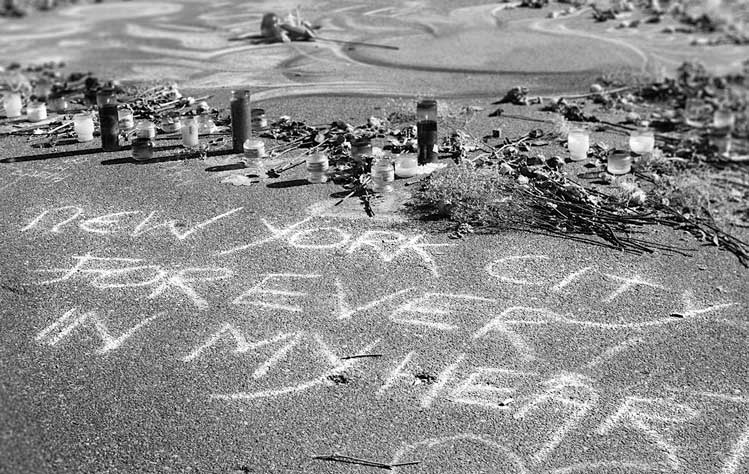
WEBSTER GROVES, Mo. — Webster University presents “9/11: A 25th Anniversary Photography Exhibition of the Terrorist Attacks in New York City,” an exhibition of photographs by Jane Martin and of observations from anthropologist and former School of Communications Dean Eric Rothenbuhler, PhD. Both lived directly across the Hudson River from the Twin Towers and documented the impact on the region in the following months.
Presented across the first floor of the Sverdrup Building and the Emerson Library Exhibition Space (Conference Room 120), the exhibition will be held now through Dec. 15, 2026. A public lecture featuring Rothenbuhler will be hosted on the anniversary of the attacks - 1 p.m. on Friday, September 11, in Sverdrup Hall, Room 123, followed by a reception in the Emerson Library Exhibition Space, directly next door to the Gallery.
“They say that every generation has had a moment, something that happened that was so profound that everyone seems to remember the impact it had on them and exactly where they were when they learned of the event, and it forever altered their view. The attack on Pearl Harbor, the assassination of President Kennedy or the murder of John Lennon are among those incidents,” said Kristina Richards, director of the Webster University’s Kooyumjian Gallery. “The attack on the Twin Towers in 2001 is one of those events. Through this exhibit and lecture, we will see and hear first-hand witnesses to the attack, how it immediately changed New York City and the country, and the lasting impact it is having on us today.”
In August 2001, Martin and Rothenbuhler relocated to Jersey City, New Jersey, directly across the Hudson River from the World Trade Center. Just weeks later, they witnessed the attacks firsthand. While Rothenbuhler observed the unfolding events as an anthropologist and kept an extensive journal documenting the cultural response, Martin spent the day photographing the collapse of the Twin Towers, the evacuation of lower Manhattan, and the extraordinary acts of compassion, mourning, and resilience that followed.
The resulting exhibition offers a rare eyewitness perspective—not focused solely on destruction, but on the profound human response that emerged in its aftermath.
Martin’s photographs document ferry evacuations across the Hudson River, crowds gathering at the waterfront to witness an unimaginable event, and the transformation of New York’s public spaces into places of remembrance and collective healing. Her images capture impromptu memorials, missing-person posters, handwritten messages, American flags, volunteers organizing relief supplies, rescue and recovery workers traveling to and from Ground Zero, and the remarkable outpouring of support that became known as “Point Thank You” along the West Side Highway.
Together, these photographs reveal how ordinary streets, parks, lamp posts, barricades, and sidewalks became temporary monuments where grief, gratitude, and hope were publicly expressed. Union Square, Washington Square Park, neighborhood firehouses, and countless city intersections became places where strangers gathered to mourn together, leaving flowers, candles, photographs, poems, and messages that transformed the city into a living memorial.
The exhibition also includes photographs made in the months following the attacks, documenting New York’s gradual recovery and the emergence of new symbols of remembrance, including the now-iconic Tribute in Light, first illuminated in March 2002. Rather than presenting history as distant memory, these images examine the cultural work required to rebuild a community after profound trauma.
As Rothenbuhler reflects, the attacks shattered assumptions about safety and permanence, forever altering how Americans understood public space, security, citizenship, and vulnerability. Nearly 3,000 people were killed on September 11, 2001, more than 6,000 were injured, and thousands of survivors, first responders, recovery workers, and nearby residents have since faced long-term health consequences. The attacks also reshaped national security policy, emergency preparedness, aviation security, and public life in ways that continue to influence everyday experience twenty-five years later.
More than a historical record, "9/11: A 25th Anniversary Photography Exhibition of the Terrorist Attacks in New York City" is an exploration of witnessing. Martin’s photographs ask viewers to consider not only what happened on September 11, but how communities respond to unimaginable loss, how public memory is created, and how photography preserves moments that might otherwise fade from collective consciousness.
By documenting both devastation and recovery, the exhibition offers an opportunity for reflection, remembrance, and conversation for those who experienced September 11 firsthand and for generations who know it only through history.
Admission is free and open to the public.
Details:
9/11: A 25th Anniversary Photography Exhibition of the Terrorist Attacks in New York
City
July 1–December 15, 2026
Lecture to be held at 1 p.m. on Friday, September 11.
Sverdrup Hall, Room 123, Webster University Campus, 8300 Big Bend Blvd, 63119.
A reception immediately follows the lecture in Emerson Library Exhibition Space.
The event is free and open to the public.